C Ruby Rose Hover
Project Overview
Seedling is a mobile app designed to support adoptees, birth families, and adoptive families through the emotional, and relational complexities of adoption reunion.
The core problem I set out to solve was the lack of emotionally safe, adoption-informed resources that acknowledge adoption and reunion as lifelong experiences rather than one-time events.
Project Goals
Help families build meaningful connection gradually.
Reduce emotional overwhelm during reconnection.
Provide structure to help families share identity, history, and stories.
Build a strong foundation for long-term relationship
Primary deliverables:
User interviews Research synthesis & personas User flows and sitemap Low- to high-fidelity wireframes
Interactive prototype Usability testing & iterations
Background
Seedling is an app designed to support adult adoptees and newly reconnected biological family members build meaningful, long-term relationships after reunion. This project was designed for adoptees who often navigate difficult emotions such as ambiguous grief, confusion, identity questioning, or boundary-setting, without accessible, trauma-aware resources. Many existing wellness or journaling apps feel too generic, while adoption-informed resources are often fragmented, outdated, or overly clinical.
Problem
There are currently no tools designed to support the relationship-building phase of reunion.Finding biological family is often seen as the final chapter, but after reunion, many adoptees and families struggle to navigate:
Emotional complexity
Fear of rejection or overstepping
Lack of shared history
Uncertainty around how to deepen the relationship


Define
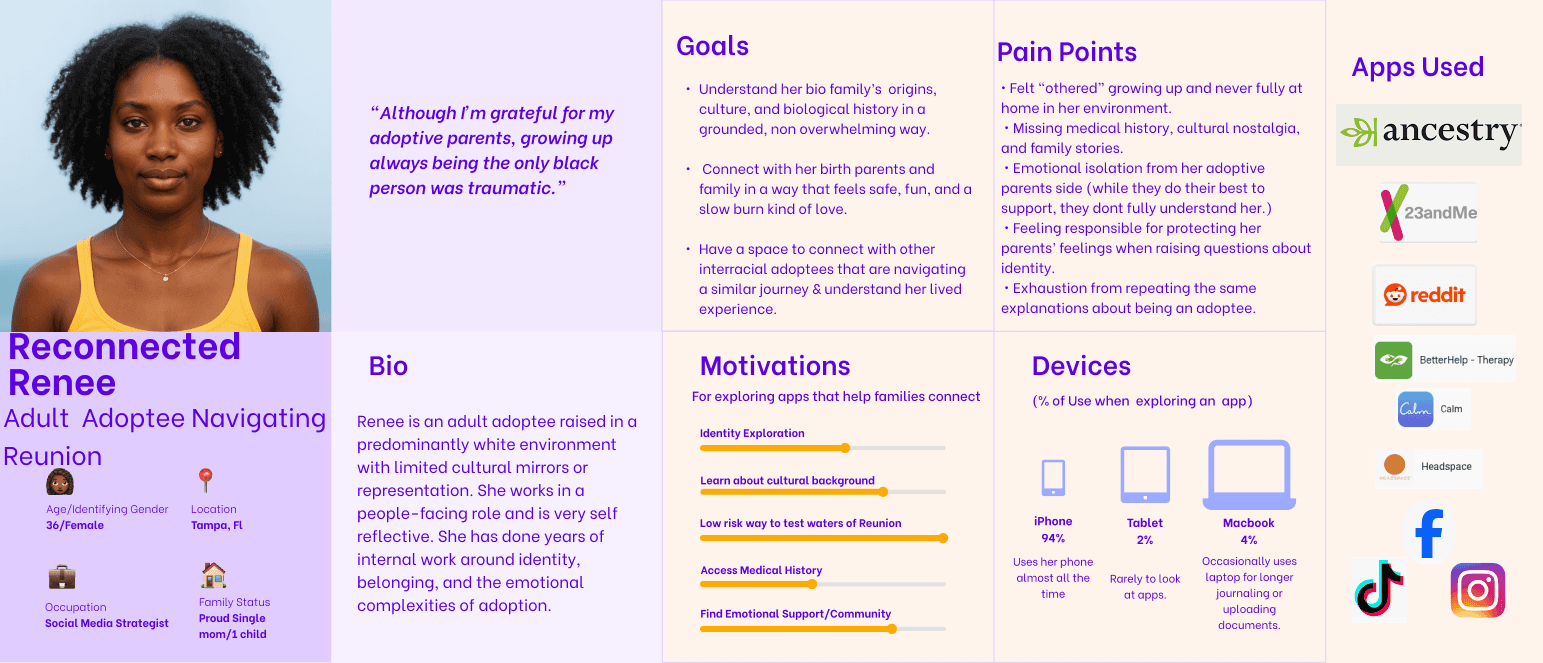
I synthesized my research using affinity mapping, clustering emotional needs, pain points, and behavioral patterns. From this process, I developed primary personas representing adoptees, bio family, and adoptive family at different stages of reunion and emotional readiness.
To support these personas, I created:
A sitemap centered around emotional entry points rather than features
Core user flows for the boundary wizard
The research directly informed feature prioritization, including:
A low-friction onboarding experience
The Daily Bloom emotional check-in
Tools for reflection and boundary-setting

User Persona

This early user flow explored a structured Boundary Wizard experience. As designing progressed, user feedback and emotional pacing considerations led me to shift toward a more flexible, user-led interaction model.
Early Concept User Flow
How Might We
Point of View
Families need support navigating the early stages of reunion so that connections can grow gradually and safely.
How might we support adoptees and family members as they navigate the emotional intensity of early reunion?
Design
My design process began with low-fidelity wireframe sketches, focusing on structure, and emotional pacing before visual polish. I iterated on task flows and emotional input screens to ensure clarity without cognitive overload. t was an essential part of this project. I developed a visual system inspired by growth, gentleness, and safety, using soft color palettes, organic shapes, and calming typography. Visual elements were intentionally understated to keep the focus on the user’s emotional experience.
Final design deliverables included:
High-fidelity screens
Interactive prototype
Test
I conducted moderated usability testing using a functional Figma prototype. I tested with multiple participants who reflected the target audience.
I asked them to complete key tasks such as:
onboarding,
completing a Daily Bloom
locate suggested actions
explore the boundary wizard
All participants successfully completed the tasks, which confirmed overall usability. However, testing revealed important opportunities for refinement.
Iterations:
Conclusion
Seedling was a deeply meaningful project that challenged me to design not just for usability, but for emotional responsibility. If I were to continue developing Seedling, next steps would include:
Testing with a broader range of adoptee experiences
Expanding accessibility testing
Collaborating with adoption-informed therapists or counselors
Developing longitudinal features for long-term emotional support
What I’m most proud of is creating an empathetic, emotionally safe product for a problem that is often overlooked. Users consistently expressed how meaningful it felt to be heard, reinforcing the impact that thoughtful human centered design can have beyond functionality alone.
Seedling High Fidelity Mock-ups
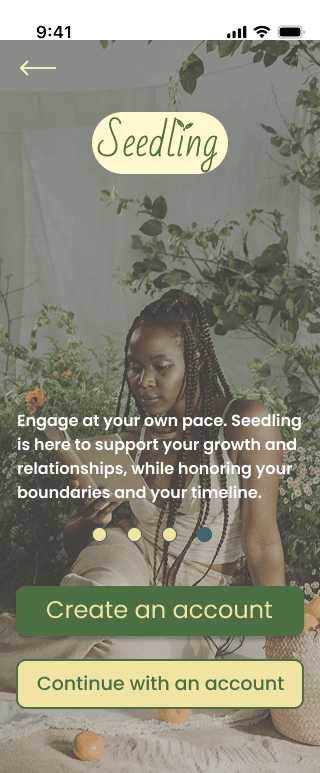


With a focus on growth, grounding and connection, I designed with an earthy color pallet, and calming, grounding language.


In version 1, the progress indicator for the habit tracker was a leaf that appears under every day that a user did a “daily bloom” check-in.
In version 2, the leaf progress indicator is replaced with a sprout that matches the branding and logo of Seedling after 80% of usability tests mentioned it.
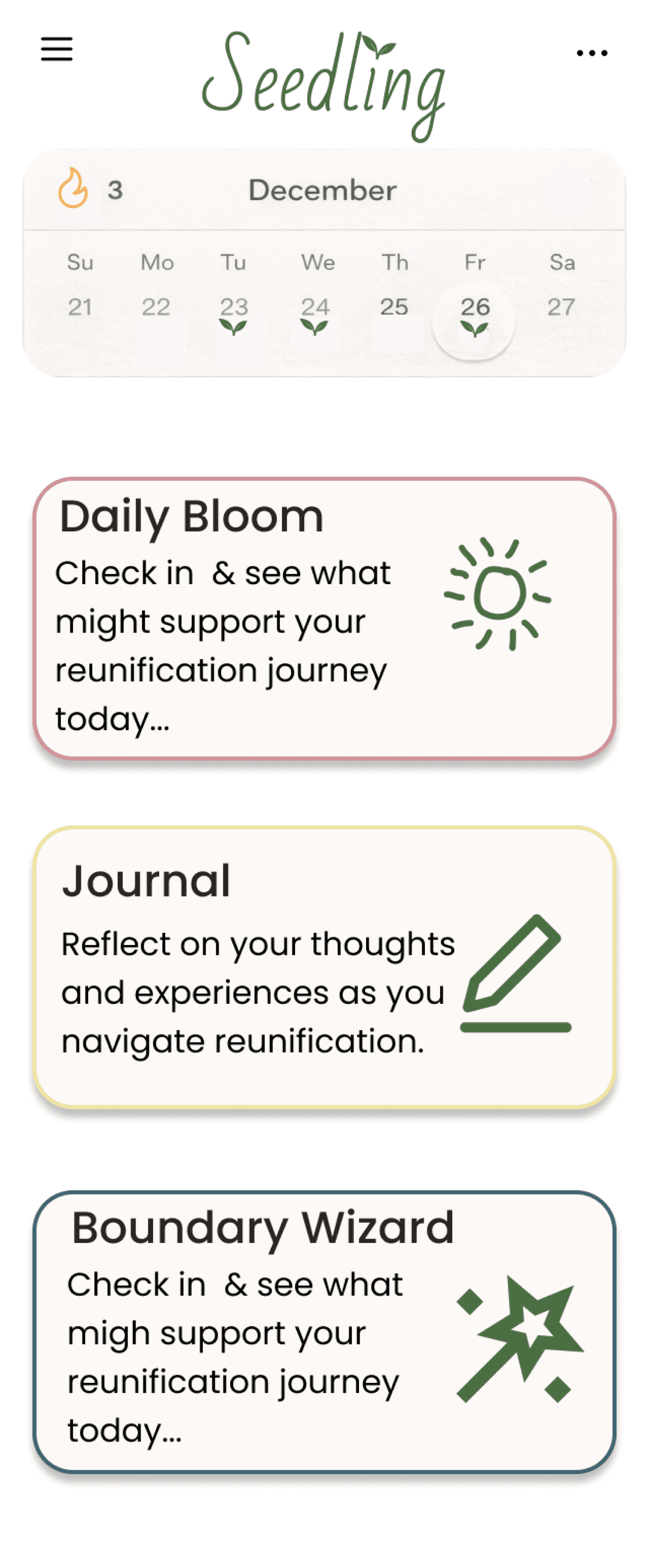
Minimalist and simplistic UI was a goal.


Low-fidelity Wireframes
The reunion process can be emotionally taxing, and I wanted to design a simple interface
that assisted with adult adoptees checking in on their emotional state, and getting support.
This would include:
Emotional check in,
Journaling in the Seedling
AI evaluation of the emotions in the journal entry,
Reaching out to family members to chat, or to part of yur support system
Completing part of a boundary wizard

Users described struggling to pace new reunion relationships. Excitement often led to over-communication, followed by emotional burnout.
To support sustainable connection, I introduced gentle guardrails in the form of:
t
daily message limits
character caps
undo send option
to encourage intentional, regulated communication.
Boundaries came up again and again in interviews. The Boundary Wizard helps users anticipate challenging moments and clarify their limits ahead of time.
4/5 users suggested using a sprout icon instead of a leaf to better communicate a selected state and stay aligned with the company name: seedling
Several users noted potential accessibility concerns with color contrast.
3/5 users responded positively to the Daily Bloom emoji flow, describing it as “intuitive” and “supportive.”
One user misunderstood a “Next” button in the Boundary Wizard, interpreting it as a way to skip content rather than proceed.
Based on this feedback, I iterated on navigation behavior, clarified button labeling, adjusted color contrast, and refined visual indicators. These insights directly improved clarity, accessibility, and emotional comprehension.
Research
To understand the emotional landscape of adoption, I conducted qualitative research focused on lived experience rather than assumptions. My research methods included:
1:1 semi-structured interviews with adult adoptees, biological family members of adult adoptees, and adoptive parents
Contextual conversations to understand language sensitivity and triggers
Secondary research on adoption trauma, identity formation, and emotional regulation
Key insights:
Users wanted support, and guidance while still being in control of building their relationships
Language mattered deeply: incorrect labels could feel invalidating or harmful
Many participants felt overwhelmed by a range of difficult emotions and lacked support during their reunion journeys.
Setting boundaries came up almost unanimously.

Affinity Map